 Loading...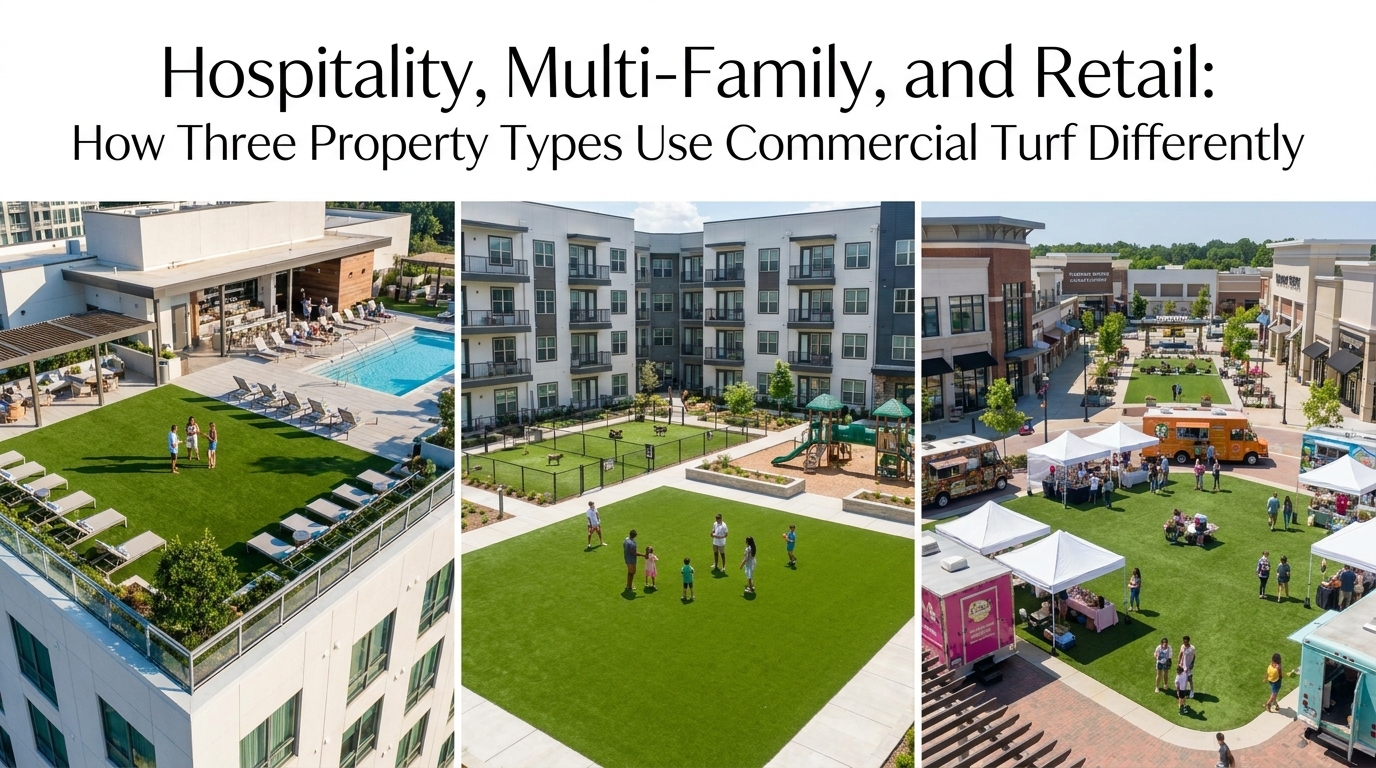
A hotel pool deck, a Class-A apartment courtyard, and a retail storefront activation might all look like "green space" on a rendering. Underneath, they're three completely different builds. That's the part specifiers, GCs, and property managers miss when they treat artificial grass like a carpet you roll out. Grass365 designs commercial turf as an engineered system — sub-base, drainage, backing, pile, and infill tuned to how the space actually gets used.
Here's how those three high-visibility property types diverge in the spec, and why picking the right system upfront changes everything about how it looks and performs five years in.
1. Hospitality: The Hotel Pool Deck & Rooftop Lounge
Hospitality turf lives a hard life. Chlorinated water, sunscreen, bare feet, cocktail spills, lounge furniture dragged across it daily, and — if it's a rooftop — brutal sun exposure with nowhere for water to go but the deck drain below.
What that means for the spec:
- Shorter, denser pile (roughly 1.25"–1.5"). Guests walk barefoot. A dense, tightly tufted face fiber feels plush without matting under lounge chairs.
- Cool-tech fiber technology. Heat-reflective yarns matter when the surface sits in full sun beside a pool. It's the same value driver Florida installers are highlighting in coverage out of Clearwater — heat performance is now table stakes for outdoor commercial spaces.
- Non-infill or low-infill systems. Nobody wants crumb rubber tracked into a hotel lobby. Grass365 commercial hospitality builds often use organic infill or infill-free constructions with a shock-pad underlayment.
- Rooftop drainage assemblies. Over a structural deck, the sub-base becomes a drainage mat and pedestal or foam base — not compacted rock. The backing has to move water fast to the deck's existing drains.
Result: a surface that looks like a manicured lawn, drains a rainstorm in minutes, and doesn't scorch bare feet at 2 p.m.
2. Multi-Family: The Class-A Apartment Courtyard & Pet Relief Area
Class-A multifamily is where turf earns its keep on the operating budget. Courtyards, dog runs, amenity lawns, and rooftop decks see 24/7 use from hundreds of residents — plus their pets. The spec has to solve for dogs, kids, events, and the leasing agent's photo shoot in the same footprint.
In pet-heavy multifamily, drainage isn't a feature — it's the whole product. If urine sits in the backing, the amenity fails within a year.
Multi-family commercial turf typically calls for:
- Fully permeable, 100%-flow-through backing in pet relief zones, paired with an antimicrobial infill (zeolite or coated silica) that captures ammonia.
- Mid-height pile (1.5"–1.75") in courtyard lawns — tall enough to read as real grass in listing photos, short enough to bounce back after a resident yoga class.
- Zoned systems. The same courtyard often uses three different turfs: a pet-optimized turf near the dog gate, a plush landscape turf in the sunbathing lawn, and a putting-green turf on the amenity green. Grass365 designs them as one continuous install with hidden seams.
- Compacted aggregate sub-base with a gravity-graded slope — the workhorse foundation that carries loads from movie-night crowds and food trucks without rutting.
The ROI story writes itself: no irrigation, no mow contract, no reseeding after every big weekend, and the pet area stops being the amenity residents complain about.
3. Retail: The Storefront Activation & Entry Display
Retail turf is a merchandising surface. It sits at the front door, wraps a pop-up, greens a sidewalk sale, or dresses a seasonal display. Foot traffic is intense but concentrated, dwell time is short, and — this is the part people miss — the surface is scrutinized from three feet away by shoppers deciding whether your brand looks premium.
The spec shifts accordingly:
- Ultra-realistic face yarn with multi-tone thatch. At close range, monochrome turf reads plastic. Retail specs use blended greens and a tan thatch layer so it photographs as real grass on customer phones.
- Shorter, resilient pile (1"–1.25"). Cart wheels, strollers, and stilettos flatten tall pile fast. A shorter, denser face recovers better between customers.
- Modular installation on hard surfaces. Storefronts sit on concrete and pavers. Grass365 uses low-profile shock pads, tape-seamed sections, or modular court-tile substrates so turf can be installed — and pulled up seasonally — without demolition.
- UV-stabilized fiber with strong warranty terms, because a faded entry after one summer is a brand problem, not just a landscape problem.
Why the Same Product Line Behaves So Differently
Every one of these specs is drawn from the same Grass365 commercial catalog. What changes is the system — how the layers are chosen and stacked for the job. Backing, sub-base, drainage, pile height, fiber shape, and infill are variables, not defaults. That's why the industry is moving toward tighter standards; the Synthetic Turf Council recently seated a new board and ASTM International just published a new standard for testing synthetic turf for PFAS, both signals that commercial buyers should expect a real engineered answer from their installer, not a sample square and a handshake.
For property owners and specifiers, the practical takeaway is simple: bring the use case to the conversation first. How many people, how many pets, how much sun, what's underneath, and what does the surface need to do at the moment a guest, resident, or customer sees it? A certified Grass365 owner can back-solve the system from there.
Next Step
If you manage a hotel, multifamily community, retail portfolio, or mixed-use property, connect with your local certified Grass365 owner to walk the site and scope a system built for your traffic pattern — not a one-size roll goods order.
Want more commercial specification content like this? Subscribe to our newsletter for straightforward guides on turf systems, ROI, and what to ask before you sign a bid.

Leave a Comment