 Loading...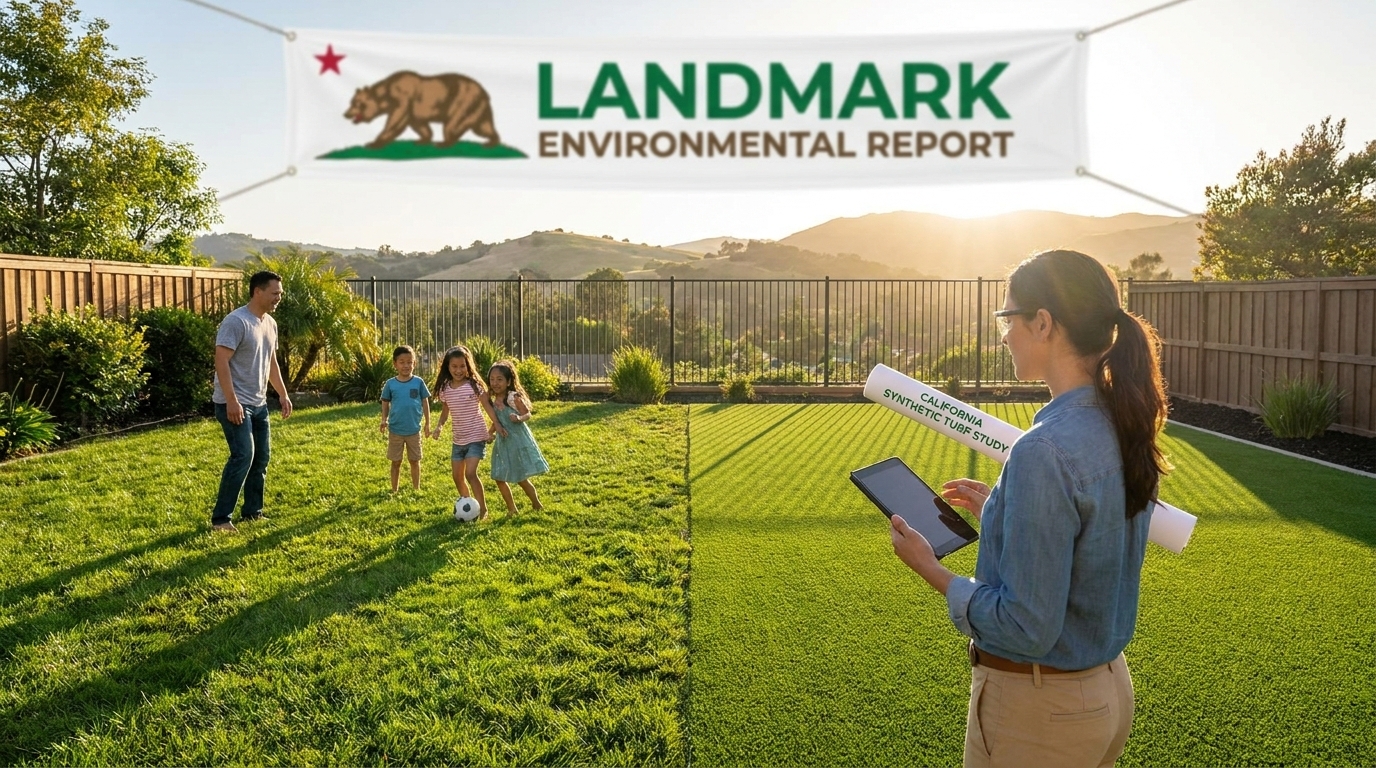
If you've ever typed "is fake grass safe for kids and pets?" into a search bar, you're not alone — and you finally have a serious answer. After more than a decade of testing, California's health agency has released one of the most thorough investigations of synthetic turf ever conducted in the United States. The verdict is reassuring, and for Grass365 homeowners it's actually the floor, not the ceiling.
What the California Study Actually Found
California's Office of Environmental Health Hazard Assessment (OEHHA), part of CalEPA, spent roughly 14 years — from 2010 through 2024 — measuring chemicals, exposure pathways, and real-world contact scenarios on synthetic turf fields. Their conclusion, published in 2024, was direct: under the conditions studied, exposure to chemicals from synthetic turf fields does not present a significant health risk to the people who play on them.
Exposures to chemicals from synthetic turf fields with recycled tire crumb rubber infill do not present a significant health risk to players under the conditions studied. — California OEHHA Synthetic Turf Study, 2024
Why does a California ruling matter if you live in Florida, Texas, Ohio, or anywhere else? Because California is the strictest consumer-safety regulator in the country. Its Proposition 65 warning list and CARB air-quality rules routinely flag products that pass muster everywhere else. When California's own health scientists spend more than a decade studying a product and land on "no significant risk," that becomes a practical national benchmark for homeowners, school boards, and HOAs.
Here's the Part Most Articles Miss
The OEHHA study focused primarily on athletic fields filled with crumb rubber — the black, recycled-tire pellets you've seen bounce up when a soccer player slides. That's the material that has drawn the most public concern over the years, and it's the material California cleared.
Grass365 backyard systems don't use crumb rubber at all.
For residential lawns, pet areas, and playgrounds, our certified owners install with sanitary sand infill and lead-free fibers. In plain terms: the ingredient that got the most scrutiny in the California study isn't in the product going into your yard. You're starting from a cleaner spec than the one the state just green-lit.
What That Means for Kids
Parents ask three questions more than any others: Can my toddler crawl on it? What happens if they fall? What if they put a handful in their mouth?
- Crawling and skin contact: Grass365 fibers are lead-free and soft-tipped, engineered for barefoot use, not stadium cleats.
- Falls: Playground systems meet ASTM head-impact ("head fall") safety requirements, with optional shock pads rated for falls from up to 12 feet — the same protection you'd expect under commercial playground equipment.
- The mouthful question: Sanitary sand infill is a clean, inert mineral — closer to what you'd find in a sandbox than in a tire yard. Optional antimicrobial infill toppings can be added for daycares, playrooms, and high-traffic family yards.
What That Means for Pets
Dogs are, honestly, harder on a yard than kids are. They dig, they pace the same fence line into dirt, and — the reason most families call us — they turn a lawn into mud after every rain. A Grass365 pet system is built for that reality:
- Lead-free fibers safe for paws, noses, and the inevitable rolling around.
- Free-draining sub-base and backing so urine flushes through instead of pooling.
- Sand infill (not rubber) that won't cling to fur or track into the house.
- Optional antimicrobial topping for odor control in kennels and heavy-use runs.
The upshot: the debate California just settled was about a material we already chose not to use in your backyard.
The Honest Caveats
We won't oversell the study. OEHHA looked at specific chemicals, specific fields, and specific exposure scenarios — not every product on every shelf. That's exactly why the material spec of your installation matters more than a general "is turf safe?" headline. When you talk with a certified Grass365 owner, ask to see the fiber's lead content documentation, the infill type, and — for play areas — the ASTM fall-height rating of the shock pad. A reputable installer, ours or anyone else's, should hand those over without hesitation.
If you want to go deeper on how commercial properties, HOAs, and multi-family communities are specifying turf with these same standards, our companion piece — Hospitality, Multi-Family, and Retail: How Three Property Types Use Commercial Turf Differently — walks through the spec decisions board members and property managers are making right now.
Your Next Step
If safety was the last question keeping you from replacing a patchy, muddy, or water-hungry lawn, you have your answer — backed by 14 years of state-funded science and a product spec that goes further than the study required. The best next move is a walk-through with a certified Grass365 owner in your market, who can measure your yard, match the right system to your kids and pets, and share the exact material certifications for the turf that would be installed.
Find a Certified Grass365 Owner Near You
Want future updates on turf safety, new installations, and product standards delivered a few times a month? Subscribe to the Grass365 newsletter — short, useful, and written for real homeowners.
Leave a Comment