 Loading...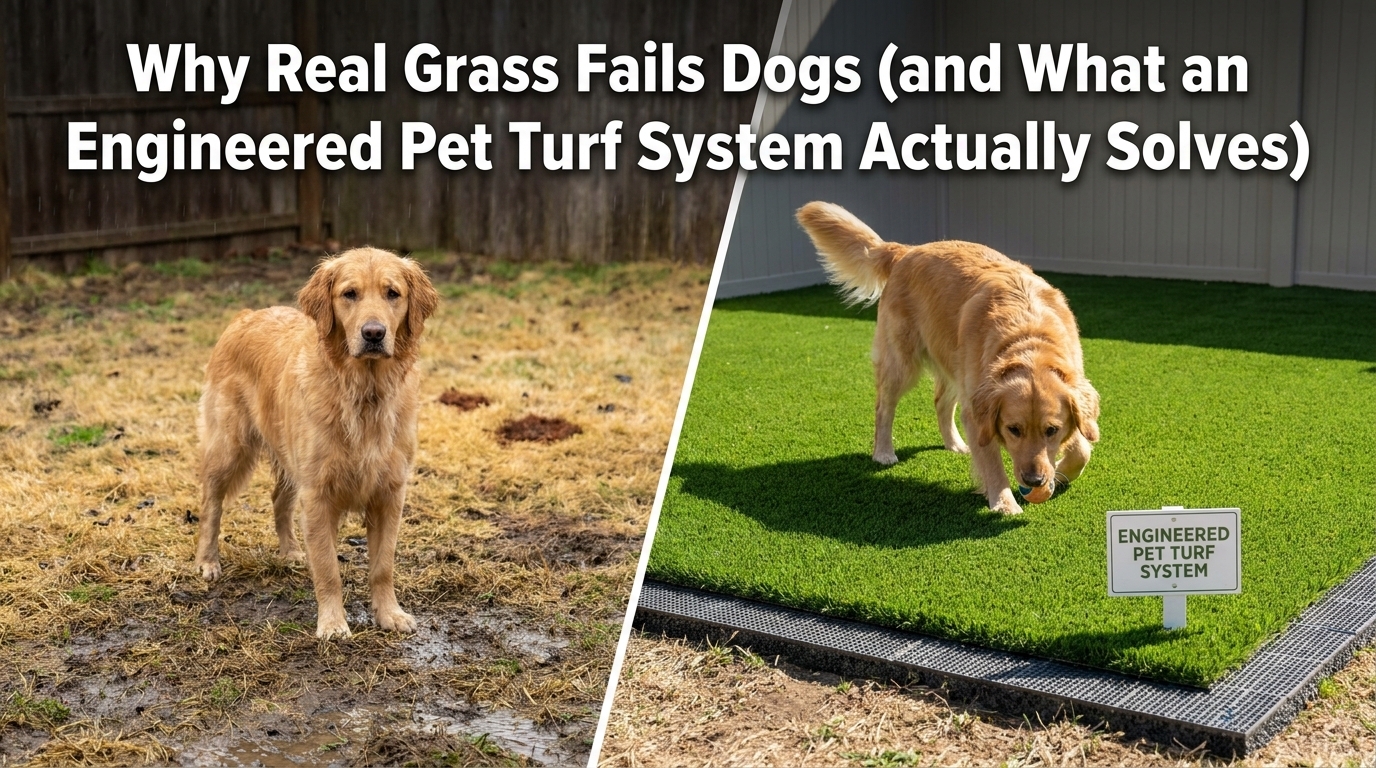
If you share a yard with a dog, you already know the drill: muddy paws in the kitchen, yellow burn spots where the lawn used to be green, and a sprinkler bill that keeps climbing every summer. Atlanta homeowners feel it more than most — humid Georgia summers, red clay that turns to soup after every thunderstorm, and shaded pockets under mature hardwoods where grass simply refuses to grow. This is a practical guide to the four ways natural lawns let dogs (and their people) down, and exactly what an engineered pet turf system does about it.
The Four Failure Points of a Natural Lawn for Pet Households
Every dog-owning household we talk to describes the same four pain points. They're not personal — they're structural. A living lawn was never designed to absorb the daily traffic, chemistry, and behavior of a family pet.
- Mud. One dog running the same fence line for a week creates a permanent trench. Add rain — and Atlanta averages more than 50 inches a year — and that trench becomes red clay slurry tracked across your floors.
- Urine odor and burn spots. Dog urine is high in nitrogen. On natural grass it scorches blades, then sits in the topsoil, releasing ammonia every time the yard warms up.
- Digging. Loose soil is an invitation. Once a dog finds it satisfying, no amount of reseeding keeps up.
- Fleas, ticks, and pests. Warm, damp, shaded turf is ideal habitat. In the Southeast, tick season effectively never ends, which means chemical treatments year-round.
What an Engineered Pet Turf System Actually Does Differently
A Grass365 pet system isn't "green carpet." It's a four-layer assembly designed around how dogs actually use a yard. Here's how each layer maps to the failure points above.
1. Compacted rock sub-base — the mud fix. Before a single blade of turf goes down, the existing soil is excavated and replaced with a compacted aggregate base. Water moves straight through it instead of pooling. No mud, no ruts, no puddles at the back door — even after a Georgia gully-washer.
2. SealTuft® backing and drainage — the odor fix. Traditional turf uses a latex backing that clogs and holds urine. Grass365's proprietary SealTuft® construction replaces that with a sealed, recyclable backing engineered for extreme drainage — rated at roughly 1,000 inches of flow per hour. Urine passes through immediately rather than sitting in the fibers. Paired with an antimicrobial infill (typically a zeolite or coated silica), ammonia is neutralized at the source instead of building up in the heat.
3. Dense, resilient fiber — the digging fix. Pet-spec turf uses a shorter, denser pile (generally in the 1.25″–1.5″ range) tufted into a rigid backing over that compacted base. There's nothing loose to dig into. Most dogs try once, find no reward, and move on.
4. Lead-free, sanitizable surface — the pest and hygiene fix. The fibers are lead-free, 100% recyclable, and — this is the part pet owners underestimate — safe to clean with diluted household bleach or standard kennel disinfectants without damaging the backing. Fleas and ticks lose their habitat because there's no organic thatch layer for them to breed in. That's why you'll find Grass365 pet systems installed in doggie daycares, veterinary clinics, boarding facilities, and municipal dog parks — the highest-traffic pet environments in the country.
"No chemical fertilizers, no weed killers, no ammonia buildup, no muddy paws. The yard that works for your dog is the yard that works for your floors."
Why This Matters for Atlanta (and Any Humid, Shaded, Pet-Heavy Market)
Atlanta is a genuinely tough environment for a residential lawn. Heavy tree canopy blocks the sun grass needs. Clay soil drains slowly. Long, humid summers accelerate pest cycles. Homeowners in Buckhead, Decatur, Marietta, Alpharetta, and Smyrna consistently tell certified Grass365 owners the same thing: they've re-sodded twice, spent thousands on drainage, and still have a mud pit where the dog runs. An engineered pet system replaces the whole cycle with a surface that stays green, drains instantly, and cleans up with a garden hose.
The same logic travels. Whether you're in Nashville, Phoenix, Long Island, or the Pacific Northwest, the failure points are identical — only the weather stacks the deck differently. The engineering answer is the same four-layer system, tuned for your climate by a local certified owner.
How to Spec a Pet Turf Install — A Quick Homeowner Checklist
- Ask about the sub-base. A proper pet install starts with excavation and a compacted aggregate base, not turf rolled over dirt.
- Ask about the backing. SealTuft® or an equivalent permeable, latex-free backing is non-negotiable for odor control.
- Ask about the infill. Antimicrobial zeolite or coated silica — not crumb rubber — for pet zones.
- Ask about pile height. 1.25″–1.5″ dense pile for high-traffic dog areas; longer piles are for aesthetics, not performance.
- Ask about cleaning. The installer should hand you a sanitization protocol on day one.
If any of those answers are vague, keep shopping. For background on the safety science behind synthetic turf, our earlier piece on California's landmark 14-year turf study is a good companion read, and property managers weighing common-area pet zones will find our commercial turf breakdown useful.
Next Step: Talk to a Certified Grass365 Owner in Your Market
Every yard is a little different — square footage, shade, drainage, how many dogs, how big, how rough. A certified Grass365 owner will walk your property, measure it, and quote a system designed for your specific pets and climate. Use the locator on our site to find the owner covering Atlanta or your local market.
Want more homeowner guides like this one — costs, product picks, and real installation stories from across the Grass365 network? Subscribe to our newsletter for practical turf advice delivered a couple of times a month. Your dog will thank you.

Leave a Comment